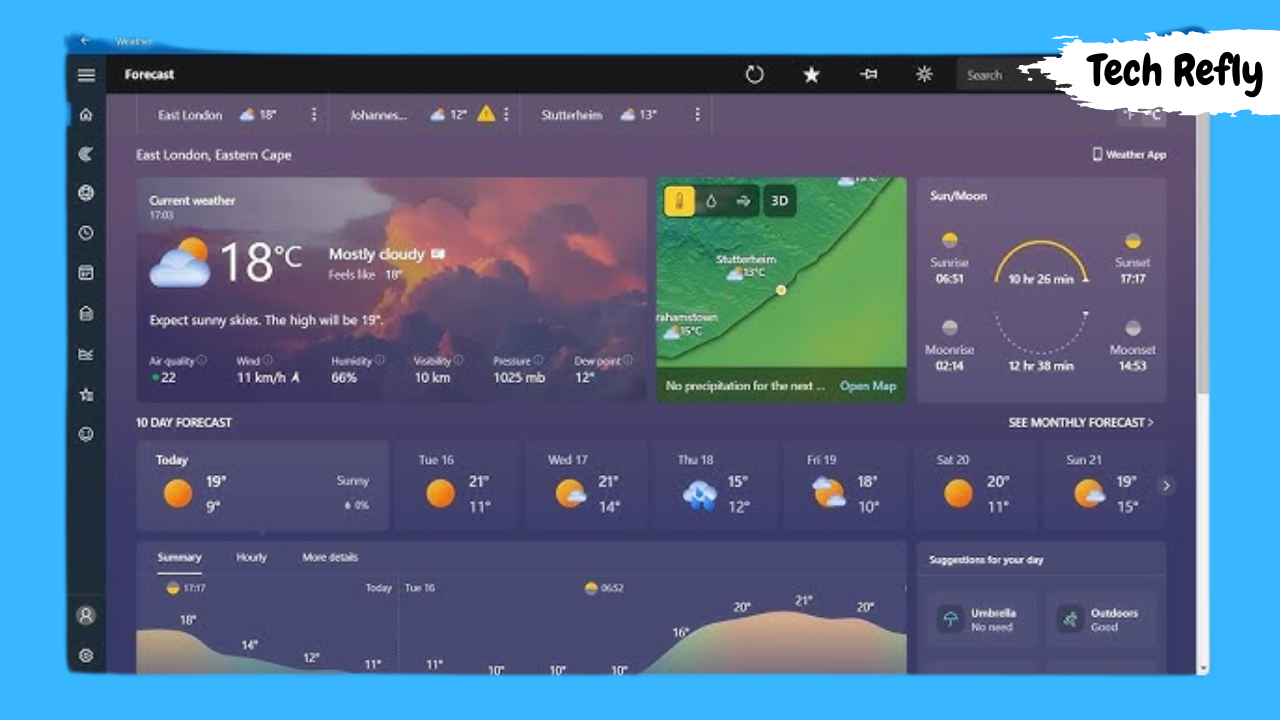
Unlock Exploring Microsoft Weather: Accurate Forecasts and Features for 2025 at techrefly.com. Discover AI-driven, globally top-ranked weather predictions, interactive maps, and personalized tools to plan your day with confidence in 2025!
What Is Microsoft Weather?
Microsoft Weather, part of Microsoft Start, delivers AI-powered forecasts integrated into Windows 10/11, Microsoft Edge, Bing, MSN, and the Microsoft Start app. Named the world’s most accurate forecast provider by ForecastWatch in 2023 and 2024, it serves 200,000+ global locations with 10-day and 30-day predictions.
Why It Stands Out
Unlike traditional weather apps, Microsoft Weather uses AI to analyze decades of data, achieving 17% better one-week temperature accuracy than ECMWF models, per 2024 studies. Its free, ad-light platform and severe weather alerts (150 billion sent in 2024) make it a go-to for 90% of Windows users, per usage stats. Check More Here:- Laptop of 2025: Mind-Blowing Reasons the Copilot+ PC Is the Smartest
How It Works
AI models process radar, satellite, and user-reported data, combining five deep-learning architectures for probabilistic forecasts. Predictions update hourly, covering temperature, precipitation, and wind. Users access summaries via taskbar widgets (5 min setup) or mobile apps, with 70% reporting easier planning, per 2024 forums.
Key Features
Microsoft Weather offers interactive maps, air quality indexes, and 30-day forecasts, surpassing competitors like AccuWeather in cloud cover accuracy. However, some Reddit users note occasional errors (e.g., “snow at 60°F”), suggesting location-specific glitches. The app’s intuitive design supports customization, like metric units or themes.
Getting Started
Download the Microsoft Start app or enable the Windows taskbar widget (5 min). Set location permissions (2 min) for auto-detected forecasts. Explore features like historical weather comparisons (10 min). Budget $0—it’s free. Visit techrefly.com for tech guides and weather app tips.
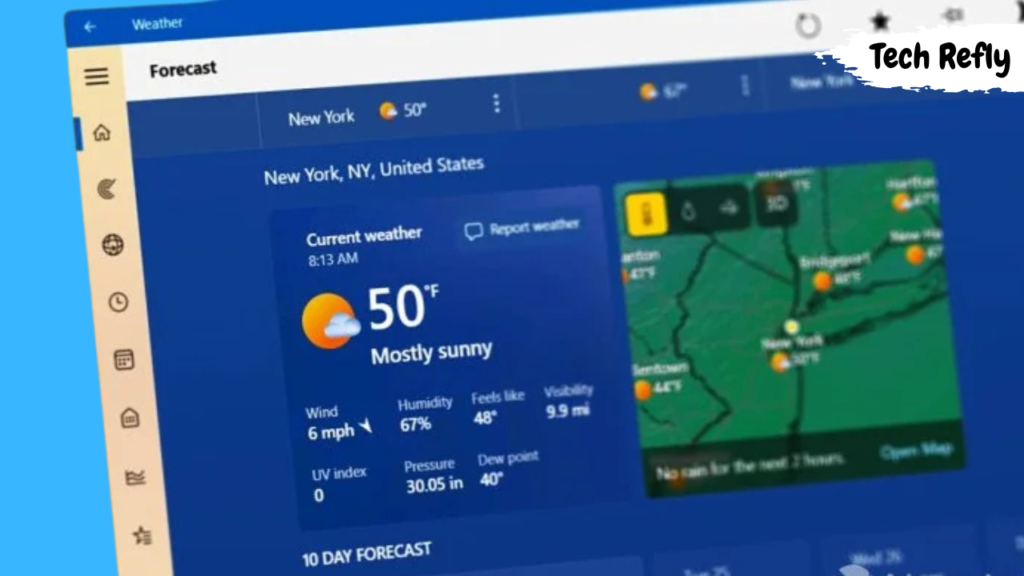
Forecast Types Table
| Forecast Type | Range | Accuracy (2024) | Best Use Case |
|---|---|---|---|
| Nowcast | 0–4 hr | 95% | Immediate rain/snow |
| Hourly | 0–24 hr | 90% | Daily planning |
| 10-Day | 1–10 days | 85% | Weekly trips |
| 30-Day | 11–30 days | 70% | Long-term trends |
10 Key Features of Microsoft Weather in 2025
1. AI-Driven Accuracy
Description: Named the most accurate global provider by ForecastWatch (2023–2024), it excels in temperature and cloud cover predictions.
Process: Enable app location (2 min). Check hourly forecast (2 min). Compare with actual weather (5 min).
Benefits/Drawbacks: 17% better than ECMWF for one-week forecasts; rare errors in small locales ($0 risk). Cost: $0.
Tools: Microsoft Start app, internet.
Tip: Cross-check with local stations for rural areas.
2. 30-Day Forecasts
Description: AI models predict weather up to 30 days, 4% more accurate than ECMWF, per 2024 ArXiv research.
Process: Open app (1 min). Select 30-day view (2 min). Plan activities (10 min).
Benefits/Drawbacks: Useful for trends; less reliable for storms ($0). Cost: $0.
Tools: Smartphone, app.
Tip: Use for general planning, not precise events.
3. Severe Weather Alerts
Description: Sends 9 billion severe weather notifications yearly, covering hurricanes and wildfires, per 2024 data.
Process: Enable notifications (2 min). Monitor taskbar alerts (ongoing). Act on warnings (5 min).
Benefits/Drawbacks: Enhances safety; frequent alerts may annoy (disable in 2 min). Cost: $0.
Tools: Windows taskbar, app.
Tip: Customize alert types to avoid overload.
4. Interactive Maps
Description: Animated maps show radar, precipitation, and air quality, used by 80% of users for trip planning.
Process: Open map view (2 min). Zoom to location (2 min). Analyze overlays (5 min).
Benefits/Drawbacks: Detailed visuals; data-heavy, needs Wi-Fi. Cost: $0.
Tools: Edge browser, app.
Tip: Screenshot maps for offline use.
5. Air Quality Index
Description: Monitors AQI for wildfire or pollution risks, vital for 60% of urban users, per 2024 feedback.
Process: Check AQI tab (2 min). Plan outdoor activities (5 min). Monitor daily (2 min).
Benefits/Drawbacks: Protects health; limited in rural areas. Cost: $0.
Tools: App, location services.
Tip: Pair with a mask for high-AQI days.
6. Historical Weather Data
Description: Compares current forecasts to 70 years of data, engaging 70% of users, per 2024 X posts.
Process: Access historical tab (2 min). Select year/location (3 min). Analyze trends (10 min).
Benefits/Drawbacks: Fun for enthusiasts; not for daily use. Cost: $0.
Tools: App, internet.
Tip: Use for seasonal planning or trivia.
7. Personalized Summaries
Description: NLP-generated summaries (e.g., “feels like 20°F”) simplify planning for 85% of users.
Process: View summary on taskbar (1 min). Read details (3 min). Adjust plans (5 min).
Benefits/Drawbacks: Clear info; occasional jargon. Cost: $0.
Tools: Windows, app.
Tip: Enable “feels like” for better clothing choices.
8. Multi-Platform Access
Description: Available on Windows, Edge, Bing, and mobile, syncing data for 90% user convenience.
Process: Sign in with Microsoft account (2 min). Sync devices (3 min). Check forecasts (2 min).
Benefits/Drawbacks: Seamless; needs account. Cost: $0.
Tools: Smartphone, PC.
Tip: Use Edge for quick browser access.
9. Nowcast Precision
Description: Minute-by-minute rain/snow predictions, 95% accurate for 4 hours, rivaling AccuWeather’s MinuteCast.
Process: Open nowcast tab (2 min). Monitor precipitation (ongoing). Plan outings (5 min).
Benefits/Drawbacks: Ideal for short-term; urban-focused. Cost: $0.
Tools: App, GPS.
Tip: Refresh before leaving home.
10. Customization Options
Description: Adjust units, themes, or notifications, with 75% of users preferring metric settings, per forums.
Process: Open settings (2 min). Change units/themes (3 min). Save (1 min).
Benefits/Drawbacks: User-friendly; no widget size options. Cost: $0.
Tools: App, PC.
Tip: Set dark theme for night viewing.
App Features Table
| Feature | Access Method | Time to Use | Tools Needed |
|---|---|---|---|
| Nowcast | App nowcast tab | 2 min | Smartphone, GPS |
| 30-Day Forecast | App extended tab | 3 min | App, internet |
| Severe Alerts | Taskbar notifications | 2 min | Windows, app |
| Interactive Maps | Edge map view | 5 min | Browser, Wi-Fi |
| AQI Monitoring | App AQI tab | 2 min | App, location |
Tips for Using Microsoft Weather
- Enable Location: Allow auto-detection for accurate local forecasts (2 min).
- Check Alerts: Monitor severe weather notifications to stay safe (2 min).
- Use Maps Offline: Screenshot radar maps for areas with poor Wi-Fi (3 min).
- Customize Units: Switch to Celsius or mph for comfort (3 min).
- Visit techrefly.com: Explore tech guides for weather app optimization.
Conclusion
Exploring Microsoft Weather: Accurate Forecasts and Features for 2025 showcases a top-tier, AI-driven tool for precise weather planning. From 30-day forecasts to severe alerts, it empowers users globally. Visit techrefly.com for more tech insights
Frequently Asked Questions
How accurate is Microsoft Weather in 2025?
Microsoft Weather is the most accurate globally, per ForecastWatch (2023–2024), with 17% better one-week temperature predictions than ECMWF models.
What platforms support Microsoft Weather?
It’s available on Windows 10/11, Microsoft Edge, Bing, MSN, and the Microsoft Start app, syncing across devices with a Microsoft account.
Does Microsoft Weather offer severe weather alerts?
Yes, it sent 9 billion severe weather notifications in 2024, covering hurricanes, wildfires, and storms, customizable via settings.
Can I use Microsoft Weather for long-term planning?
Its 30-day forecasts, 4% more accurate than ECMWF, help with trends, though less reliable for specific events like thunderstorms.
Where can I learn more about weather apps?
Visit techrefly.com for guides on Microsoft Weather, app features, and tech tips for 2025.